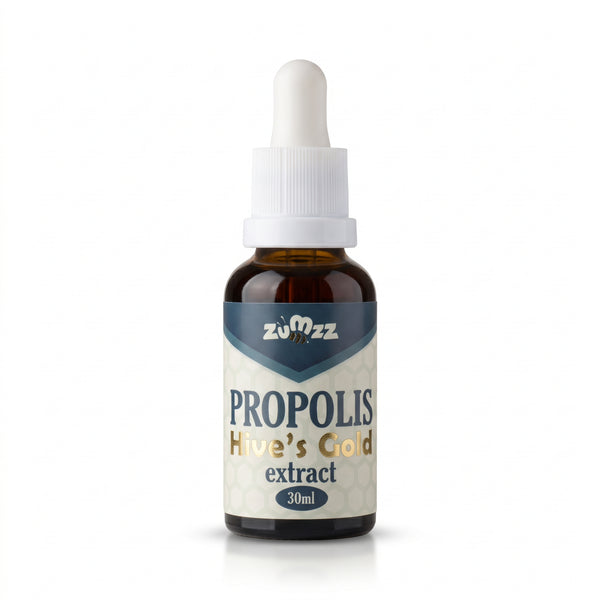
Propolis is a powerful natural antioxidant with antibacterial, antiviral, and regenerative properties.
It can help soothe inflamed acne, accelerate recovery from cold sores, and support the healing of superficial wounds and burns.
In ointment form, it is often used to relieve symptoms of hemorrhoids and dry, irritated skin. Unlike alcoholic propolis drops, which are used for short-term application, propolis ointments and creams create a protective layer and provide longer-lasting care for damaged tissue.
Healing properties of propolis for the skin?
Propolis is rich in resins, essential oils, beeswax, and, most importantly, flavonoids—powerful antioxidants that protect the skin from oxidative stress and premature aging. An analysis of the chemical composition and pharmacological properties of propolis documents a high content of polyphenols responsible for protecting skin cells.
Its effects on the skin are multifaceted:
- Antibacterial and antifungal action destroys bacteria and fungi on the skin's surface, preventing infections—as confirmed by a review of the antiviral, antibacterial, and antifungal properties of propolis .
- Anti-inflammatory action reduces redness, swelling, and irritation, making it ideal for sensitive and inflamed skin, as highlighted by a review in the International Journal of Molecular Sciences .
- Regenerative (epithelializing) action stimulates skin cell renewal and accelerates the formation of new tissue, thereby shortening wound healing time, as documented by a comprehensive review in Biomedicine & Pharmacotherapy.
Can propolis help with acne and pimples?
Acne (Acne vulgaris) occurs when skin pores become clogged with sebum (oil) and dead cells, creating an ideal environment for bacteria (Cutibacterium acnes) to multiply. This leads to inflammation, redness, and the appearance of painful pimples.
Thanks to its antibacterial properties, propolis directly targets the bacteria that cause acne. A clinical study on the topical application of propolis for acne shows a statistically significant reduction in inflammatory lesions.
Additionally, a clinical study proves that a combination of propolis, tea tree oil, and aloe vera reduces the acne severity index by 68% and the total number of lesions by 64%—outperforming erythromycin antibiotic cream, while the latest study in Dermatology and Therapy (2026) confirms the anti-inflammatory effect of the propolis + aloe vera combination on inflammatory biomarkers in the skin.
How to apply it: Apply a thin layer of propolis cream to clean skin, or use a cotton swab to apply a drop of propolis tincture directly onto an inflamed pimple, preferably at night before going to bed.
Propolis for wounds, burns, and eczema
The skin has a fascinating ability to self-repair. Even after a cut or scratch, it immediately initiates a complex healing process: it stops bleeding, sends out defense cells, and begins building new tissue.
In this process, propolis is studied as a natural ally. Its ability to create a protective, resinous layer on the skin's surface makes it a sort of natural bandage. This layer can help protect the sensitive area from external influences, while the bioactive compounds in propolis participate in processes related to tissue repair.
A study on the antibacterial, antifungal, and regenerative activities of propolis confirms accelerated epithelialization and reduced bacterial contamination of wounds treated with propolis.
For chronic skin conditions such as eczema and neurodermatitis, propolis ointment relieves unbearable itching, reduces flaking, and deeply nourishes dehydrated skin. A review in Biomedicine & Pharmacotherapy (Oryan et al., 2018) lists propolis as one of the most studied natural wound-healing agents, with over 345 citations in academic literature.
Note: Never apply pure alcoholic tincture (propolis drops) directly to a large, open wound, as the alcohol will cause severe pain and additional tissue damage. For open wounds, always use propolis ointment or cream.
Propolis for cold sores
The herpes simplex virus causes the appearance of painful, watery blisters on the lips. However, it is interesting that herpes rarely appears without warning. Many people first feel a slight tingling, tightness, or itching. It is as if the skin whispers a few hours in advance that something is coming—and this is precisely the moment when propolis is most commonly used.
Because propolis has strong antiviral activity, it is one of the most effective natural remedies for suppressing herpes. A study on the antiviral activity of aqueous propolis extracts identifies specific compounds that interfere with viral replication. Additionally, new studies cite propolis as one of the natural treatments with clinical evidence for herpes labialis.
If propolis drops are applied to the lip as soon as you feel the first tingling and tightness (before the blister erupts), it can completely prevent a herpes outbreak. If a blister has already formed, regular application of propolis (3 to 4 times a day) will dry out the herpes and cut its healing time in half.
Of course, propolis will not eradicate the virus from the body, but it serves as an excellent natural preparation to shorten the duration of viral symptoms and minimize their impact.
Propolis ointment for hemorrhoids
Hemorrhoids are swollen, inflamed veins in the anal area that cause pain, itching, and bleeding. Although they are rarely discussed, this is one of the most common problems in the adult population.
Due to its anti-inflammatory and protective properties, propolis ointment is often used as natural support for this uncomfortable condition.
Because of its astringent (tightening) and anti-inflammatory effect, propolis ointment has proven to be an exceptional natural solution for this unpleasant problem.
It relieves inflammation, reduces swelling, and stops bleeding, while the beeswax and oils in the ointment base soothe irritation and itching.
The ointment is applied locally, after hygiene, 2 to 3 times a day.
What to choose: Drops, ointment, or cream?
|
Product form |
Texture and properties |
Best used for… |
|
Alcohol-based liquid, drying. |
Spot treatment for herpes or individual pimples. |
|
|
Propolis ointment |
Greasy, thick base (wax/petroleum jelly). Creates a strong protective film. |
Wounds, hemorrhoids, severe eczema, cracked heels. |
|
Propolis cream |
Lightweight, absorbs quickly, leaves no greasy residue on the skin. |
Daily facial care, acne, soothing redness. |
Note: This text is for informational purposes only and is not a substitute for professional medical or dermatological advice. Those allergic to bee products should exercise caution. For the diagnosis and treatment of health problems, always consult your doctor.