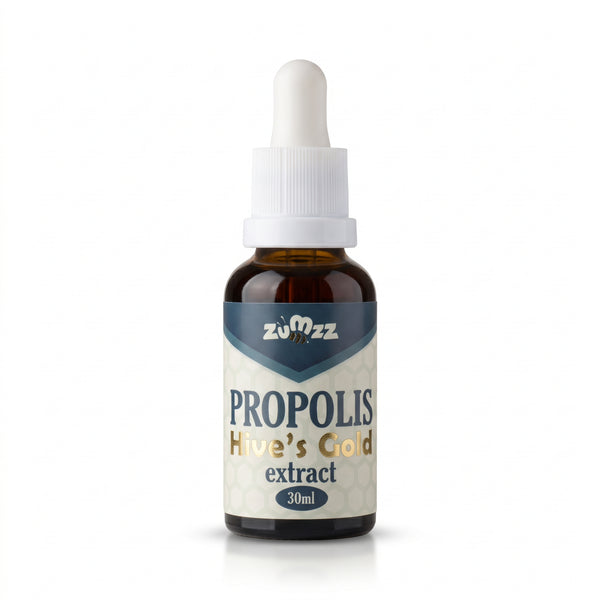
Propolis creates a protective layer on the stomach lining, soothing inflammation and accelerating healing in cases of gastritis and ulcers.
Its selective antibacterial activity makes it an excellent supportive therapy in the fight against the stubborn Helicobacter pylori bacterium, while its antifungal properties effectively suppress the overgrowth of the Candida albicans fungus.
It is best taken in the form of drops diluted in lukewarm water, on an empty stomach, before a meal.
How does propolis affect the stomach and digestive system?
Propolis is rich in polyphenols, especially flavonoids, which have pronounced anti-inflammatory activity. A comprehensive review of the pharmacological properties of propolis confirms that flavonoids like quercetin and kaempferol inhibit key inflammatory pathways in the lining of the digestive tract.
The gastric mucosa is not a passive lining that protects the stomach from acid. It is a living, dynamic, and constantly regenerating protective layer: every few days, its cells are replaced with new ones to withstand one of the most acidic environments in the human body.
Let’s return to the hive and the significance of propolis for protecting the bee colony: if this substance is important for preserving its environment and is considered a key to safety, we can view our gut microbiota in the same way, as the key to the safety of our immunity.
The balance and health of our digestive system are increasingly being researched and linked to the overall immune system of the body. However, when inflammation, infection, chronic stress, or certain medications disrupt this sensitive system, the mucosa becomes irritated and vulnerable – and this subsequently manifests in various ways and ailments.
This is exactly where the potential of propolis is being explored. When ingested, its bioactive compounds are linked to the reduction of oxidative stress and inflammatory processes that can contribute to tissue damage.
Unlike synthetic antibiotics that often destroy both good and bad bacteria in the gut, propolis acts selectively - it targets pathogenic microorganisms while simultaneously preserving and promoting the growth of healthy gut microflora.
A review in Molecules (Zullkiflee et al., 2022) highlights the immunomodulatory effect of propolis on gut immunity, which makes up nearly 80% of the total immune system.
Does propolis help with ulcers and gastritis?
Gastritis is an inflammation of the stomach lining that causes pain, heartburn, nausea, and a feeling of heaviness in the stomach. If left untreated, it can lead to the formation of an ulcer. People suffering from gastritis often describe the feeling as if their stomach is “burning” or “scratched from the inside.”
Propolis directly reduces the inflammatory process on the stomach walls. Its regenerative properties stimulate epithelialization, i.e., the renewal of damaged mucosal cells, thereby accelerating ulcer healing.
A review of wound healing with propolis documents accelerated epithelialization and reduced inflammation in tissues treated with propolis.
Propolis also mildly regulates the secretion of stomach acid, reducing the sensation of burning and heartburn.
How to use propolis for the stomach?
For stomach ailments, it is recommended to take 15 to 20 propolis drops diluted in half a glass of lukewarm water or mild tea (e.g., chamomile or yarrow), 2 to 3 times a day.
It is best taken on an empty stomach, about 30 minutes before a meal, so that the solution can coat the stomach lining undisturbed.
Many people notice the most relief at this time. Before food and the digestive processes take over, the stomach is calmer and more rested, and this is the moment when propolis is traditionally used as part of a routine for supporting the digestive system.
For people with a very sensitive stomach, it is recommended to use alcohol-free propolis drops or native propolis in capsules.
*Please note that propolis is not a substitute for therapy prescribed by a doctor.
Fighting Helicobacter pylori? Can it help?
We didn't call it a fight by accident—Helicobacter pylori is an extremely resilient bacterium that survives in the acidic environment of the stomach and is the main cause of chronic gastritis and ulcers. While most microorganisms would perish very quickly in the highly acidic environment of the stomach, H. pylori manages to settle there and persist for years.
A comprehensive review of the mechanisms of action of propolis on H. pylori shows that propolis acts in two ways:
- it directly inhibits the growth and reproduction of the bacteria
- it simultaneously reduces inflammation of the stomach lining.
Propolis prevents the bacteria from attaching to the stomach wall and interferes with the formation of its protective biofilm, as confirmed by a study on the inhibitory effect of propolis on H. pylori and urease.
Due to the challenges posed by treatment and the persistent return of the bacteria to the stomach, an increasing number of experts and phytotherapists view propolis as a potential supportive therapy alongside prescribed treatment or as part of a preventive approach after successful healing.
Propolis as an aid for Candida (Candida albicans)?
Candidiasis is an infection caused by the overgrowth of the fungus Candida albicans, which is otherwise a normal inhabitant of our gut. It is not an enemy in itself but becomes a problem when it overgrows, which most often happens after a drop in immunity, long-term use of antibiotics, or a diet rich in refined sugars.
Propolis has a powerful antifungal effect. A study on the antifungal activity of propolis on clinical isolates of Candida shows that propolis inhibits Candida virulence factors, preventing the fungus from transforming from a harmless form into an invasive form that breaches the gut wall.
Additionally, a study on the antifungal activity of propolis extract confirms the effectiveness of propolis in treating vulvovaginal candidiasis.
For suppressing intestinal Candida, taking propolis drops (about 20 drops, 3 times a day) in combination with a strict anti-Candida diet (no sugar and white flour) provides excellent results.
However, it is important to emphasize that symptoms such as bloating, fatigue, or digestive discomfort are not in themselves proof of intestinal candidiasis, and it is always advisable to consult a doctor before self-medicating.
Note: This text is for informational purposes only and is not a substitute for professional medical advice. For diagnosis and treatment of health problems, especially chronic gastritis, Candida, and H. pylori infections, be sure to consult your doctor.