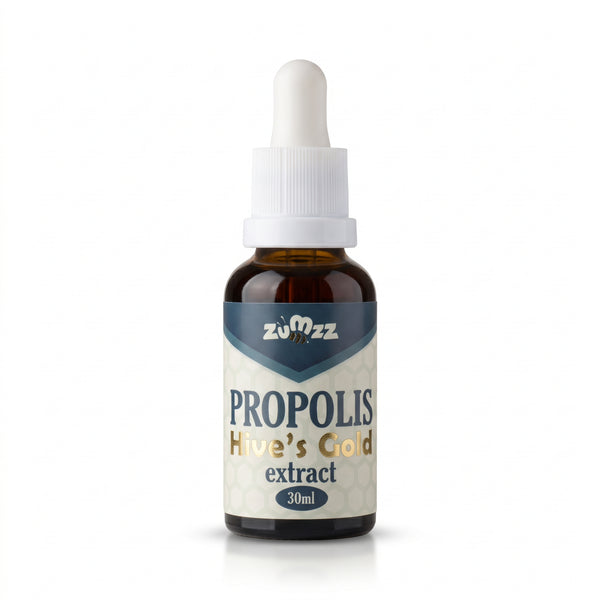
Known since ancient times as a “natural antibiotic,” propolis is one of the most precious gifts from the beehive. Although honey is the best-known bee product, propolis is the true silent guardian of the bee colony: its shield, protector, and natural disinfectant system.
Its applications range from soothing the common cold and sore throat to caring for problematic skin and supporting the digestive system.
Today, it is used by millions of people worldwide, and scientific research increasingly confirms its effectiveness and importance.
Science is at its best when it confirms that the gifts of nature, when treated in the right way, are the best help for ailments that every one of us has encountered many times in life.
What is propolis and how is it made?
Propolis is a resinous substance that bees produce to protect the hive, and it is known for its powerful antibacterial, antiviral, and anti-inflammatory effects.
It has been known for centuries as a true gift of nature, and an increasing number of households rely on its benefits in all seasons, not just in winter. It is most commonly used for immune support, soothing a sore throat, caring for problematic skin, and supporting the digestive system.
It comes in various forms, including alcohol-based drops, sprays, ointments, and native (alcohol-free) propolis, making it adaptable for children, pregnant women, and adults.
The very name “propolis” (from the Greek words pro = before and polis = city, meaning “defense of the city”) is extremely precise and gives us insight into the functioning of this magical product of tireless bee labor.

If we imagine the beehive as a well-organized city, propolis is its defensive wall, disinfection service, and public health system all in one. Without it, the bee colony would be much more vulnerable to bacteria, fungi, viruses, and other environmental threats.
It is a resinous, sticky substance that worker bees collect from the buds, bark, and leaves of trees, most commonly poplar, birch, and conifers. Bees mix this plant resin with their own enzymes and beeswax, creating a unique substance rich in biologically active compounds.
What is propolis used for in the hive?
Bees use it as a building material to seal cracks in the hive, but its primary role is sterilization.
Propolis coats the interior of the hive, protecting the bee colony from the invasion of bacteria, viruses, fungi, and parasites by creating an almost sterile environment despite the humidity and heat – conditions in which microorganisms would otherwise easily spread.
It is interesting that bees also use propolis to “mummify” larger intruders, such as insects or small rodents that die inside the hive and cannot be carried out. By covering them with propolis, they prevent decomposition and the development of harmful microorganisms, and this fascinating example further demonstrates how powerful its natural protective function is.
What is propolis composed of?
Its composition is extremely complex and depends on the geographical origin and the plant species from which it was collected.
On average, it contains 50% resin, 30% wax, 10% essential oils, 5% pollen, and 5% other organic substances. To date, scientists have identified more than 300 different compounds in propolis, among which flavonoids and phenolic compounds occupy a special place, responsible for its antioxidant and anti-inflammatory properties, as confirmed by a comprehensive review published in the journal Molecules.
Medicinal properties? What is propolis good for?
Propolis is unique in nature because it acts simultaneously as an antibacterial, antiviral, antifungal, and anti-inflammatory agent. According to a review of the pharmacological properties of propolis published in Chinese Medicine, propolis has proven effective in treating a wide range of health issues.
Its uniqueness lies in the fact that it does not act on just one organ or one symptom. Instead, propolis supports the body's natural defense mechanisms, which is why it has been used for centuries as part of traditional medicine in Europe, Asia, and South America.

Its most important properties include:
- Strengthening immunity: Regular consumption of propolis can boost the immune system and increase the body's resistance to seasonal infections. A systematic review in the journal Nutrients confirms the immunomodulatory effect of propolis in adults. Many people reach for propolis precisely during the transitional periods of the year, in autumn and winter, when attacks on the immune system are strongest. Its advantage is that it does not only act when symptoms appear, but can also be part of a daily preventive routine.
- Respiratory tract and throat: It quickly calms a sore throat, relieves coughs, and helps with hoarseness and sinus inflammation. A study on the antiviral and immunomodulatory activities of propolis documents its effectiveness in respiratory infections. It is no coincidence that propolis is one of the most common ingredients in throat sprays and lozenges. Its ability to create a protective layer on irritated mucous membranes often brings quick relief from burning and scratching in the throat.
- Oral hygiene: It prevents the accumulation of dental plaque, calms gum inflammation (periodontitis), and accelerates the healing of canker sores. A systematic review and meta-analysis notes a significant reduction in gum inflammation. Due to its antimicrobial properties, propolis is increasingly found in natural toothpastes and mouthwashes.
It is important to know that alcohol-based propolis is not recommended for application on open wounds and canker sores due to potential irritation – but nature has also shown its power here through native propolis, which is indicated for oral ailments, and many confirm that external compresses on the cheeks help them with inflammation in the oral cavity!
- Skin health: It accelerates the healing of wounds, burns, and acne, and is extremely effective in suppressing herpes. A clinical study shows that propolis outperforms antibiotic creams in the treatment of acne. Its anti-inflammatory action and ability to stimulate tissue regeneration are the reasons why it has long been used in ointments and creams for sensitive and problematic skin, and it is increasingly popular for the skin care of adolescents with breakouts and acne.
- Digestive system: It helps in the regeneration of the gastric mucosa in gastritis and fights against the Helicobacter pylori bacteria. A comprehensive review in the International Journal of Molecular Sciences confirms its inhibitory effect on H. pylori.
Research suggests that its antioxidant and anti-inflammatory properties could play an important role in preserving the integrity of the digestive system's mucous membrane and reducing oxidative stress.
Antiviral and antibacterial action of propolis
Propolis acts as a natural shield against pathogens. The flavonoids in propolis interfere with viral replication and destroy bacterial cell walls, as documented by a review of the antiviral, antibacterial, antifungal, and antiparasitic properties of propolis (Foods, Zulhendri et al., 2021).
For this reason, propolis is often described as a natural answer to the challenges of the modern age, in which bacterial resistance to antibiotics is becoming an increasingly serious global problem.
Unlike synthetic antibiotics that destroy both good and bad bacteria, propolis acts selectively, does not disrupt the natural intestinal flora, and is not associated with the same pattern of resistance development. This is precisely why scientists have been intensely researching its potential as a complementary natural agent in recent years, as pointed out by a review in the MDPI International Journal of Molecular Sciences (Martinotti et al., 2025).
It is important to emphasize that propolis is not a replacement for antibiotics prescribed by a doctor, but it can represent a valuable addition to general health care and support for the body.
Which form of propolis to choose?
Today, several forms of propolis are available on the market, and the choice depends on your specific needs and the ailments you want to treat.
|
Form of propolis |
Best for… |
Note |
|---|---|---|
|
Alcohol-based drops (tincture) |
Immunity, general health, disinfection |
Contains alcohol, not for children and pregnant women. |
|
Alcohol-free drops |
Children's immunity, sensitive individuals |
Mild taste, safe for children. |
|
Propolis spray |
Sore throats, canker sores, oral hygiene |
Precise application directly to the painful area. |
|
Ointment and cream |
Acne, herpes, wounds, hemorrhoids |
Exclusively for external application on the skin. |
|
Native propolis (capsules/powder) |
Long-term immunity, digestion |
Retains all nutrients without extraction. |
When choosing a product, also pay attention to the quality of the raw material and the origin of the propolis. Since its composition depends on the plant world surrounding the bees, propolis from different regions may contain different concentrations of bioactive compounds.

Allergies and side effects: Who should be careful?
Although propolis is generally very safe for use, it is important to know that it can cause allergic reactions in people who are already allergic to bee products (honey, pollen, bee stings). Cleveland Clinic (2026) and WebMD (2025) cite contact dermatitis and mucous membrane irritation as the most common side effects.
Symptoms of an allergy to propolis usually include redness, itching, or a rash on the skin (with external application) and swelling of the lips and stinging in the mouth (with oral application).
Advice: Before first use, perform a simple test. Apply one drop of propolis to the inside of your forearm. If no redness appears after 24 hours, propolis is most likely safe for you.
Pregnant and breastfeeding women are advised to be cautious and consult a doctor before use.
Note: This text serves exclusively for informational purposes and is not a substitute for professional medical advice. For the diagnosis and treatment of health problems, be sure to consult your doctor or pharmacist.